
There’s a silent problem in the world of marketing and business: most companies do a lot, but move very little.
En este Artículo encontrarás:
ToggleThey post, launch campaigns, generate ideas, subscribe to tools… yet stay stuck in the same pattern: unstable results, unpredictable growth, and a constant feeling that “something’s missing.”
The truth is simple:
You don’t need more work.
You need a system.
For more than six years working with service-based businesses, e-commerce brands, and personal brands, we’ve discovered something that completely changed the way we operate:
A business grows predictably when everything it does is connected to a single system: attract, educate, sell, and retain.
That conviction is where the Excala Method was born—a strategic framework designed to turn scattered actions into a circuit of consistent, measurable growth.
A method that doesn’t just organize, but integrates: strategy, structure, execution, and scaling, aligned with the real journey of the modern customer—from first touch to long-term loyalty.
Most approaches focus only on parts of the process: some on content, others on sales, ads, or branding.
But customers don’t buy in parts.
Customers live a full experience.
McKinsey defined this years ago: the customer journey is no longer linear; it’s a cycle, where the post-purchase experience influences growth just as much as the initial discovery stage.
And models like HubSpot’s Flywheel proved that growth happens when every area is connected and constantly feeding into the rest.
The Excala Method takes that systemic vision and brings it down to earth for real businesses—especially those that need predictable sales, clear offers, solid communication, and processes that don’t depend on improvisation.
That’s why our methodology rests on two fundamental axes:
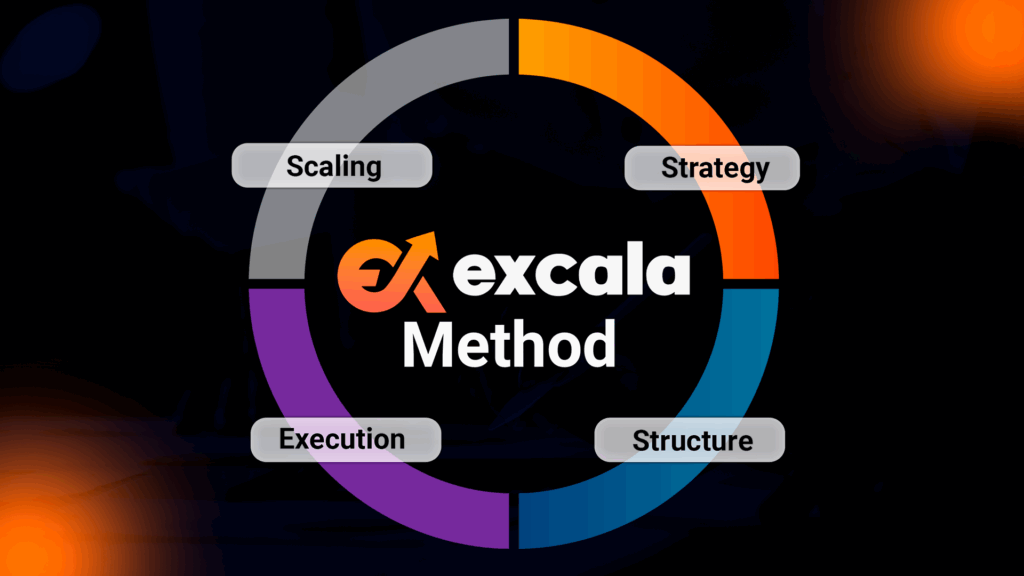
When these two dimensions are aligned, the business stops being a collection of disconnected efforts and becomes an integrated system that attracts, converts, and scales consistently.
Most marketing methods are built as a sequence: “do this, then do that.”
But that linear approach is exactly what keeps businesses stuck in cycles of effort without progress.
That’s why the Excala Method® starts from a core premise:
A business grows predictably when everything it does is connected to a single system designed to: attract, educate, sell, and retain.
This principle is what makes the Excala Method different from any “standard marketing strategy”:
It’s a living system, designed to grow.
In day-to-day operations, this is what actually happens:
What holds you back isn’t lack of effort.
It’s lack of integration.
That disconnect is expensive—in time, money, team energy, reputation, and missed opportunities.
The Excala Method® exists to correct precisely that problem.
McKinsey, one of the world’s leading consulting firms, showed that the customer journey is no longer linear.
There is no longer a rigid “funnel” where someone enters and simply exits as a customer.
Today, the process is circular:
It’s a system, not a straight line.
A cycle, not a one-way path.
To sustain that cycle, a company needs alignment—not improvisation.
The Excala Method restores that alignment.
When HubSpot introduced the Flywheel model, it changed the game by proving that growth doesn’t happen through isolated steps, but through a continuous, self-reinforcing cycle:
Attract → Engage → Delight
Inbound & Flywheel: attract–engage–delight to drive growth through experience.
The Excala Method embraces that vision—but adapts it to a more practical, sales-driven reality:
Attraction → Interaction → Sale → Loyalty
That’s the foundation of our customer map.
And when we connect it with the 4Es, we get a system that is replicable, measurable, and robust.
None of the 4Es works in isolation:
When a business adopts the Excala Method, something fundamental shifts in its performance:
This is the foundation
If a business fails at strategy, everything else turns into noise.
Strategy defines the playing field, the direction, and the boundaries. Without it, the business is condemned to drift.
But strategy is not “what we’re going to do.”
Strategy is the action framework that defines what we’ll prioritize, why, and for whom.
Companies that grow predictably have radical clarity on three things:
Most businesses define their “ideal client” from imagination, not evidence.
The Excala Method digs into:
And what those clients have in common.
This process cuts through illusion and leaves only reality:
the clients that actually keep the business alive.
You don’t scale a brand, a campaign, or a piece of content.
You scale offers.
And as Alex Hormozi teaches: if the offer isn’t irresistible, marketing has no real foundation.
At Excala, we put the offer under a microscope:
The offer is the heart that pumps blood through the entire system.
Strategic messaging is not a slogan. It’s not about getting attention; it’s about creating preference.
This is where we build the strategic angle—the narrative that positions your brand.
Without strong strategy, you won’t attract the right audience—and without the right audience, no marketing can save you.
This is where most businesses break.
Strategy exists—but there’s no operating system to turn that strategy into real sales.
Structure is the difference between “wanting to grow” and “building a system that grows.”
While other methods talk about funnels as something abstract, Excala Marketing lands it in concrete, connected components that together form the Conversion Architecture:
Not a generic funnel.
A funnel designed around your business model, operational capacity, and customer behavior.
Content not to entertain, but to move people through stages:
Without a CRM, there’s no real scaling.
Without automation, your team’s energy gets drained.
Nothing is left to chance:
Structure is what lets your business move from “people doing random tasks” to “a system that runs with efficiency.”
Without structure, your audience gets lost, goes cold, or never understands why they should buy from you.
This is where we separate companies that grow from companies that merely survive.
Execution is not “doing a lot of things.”
Execution is doing what actually moves the needle—with precision, rhythm, and consistency.
The Excala Method® leans on proven frameworks like 4DX and OODA to build an execution protocol that doesn’t depend on motivation, but on system.
One core goal per quarter.
Not three. Not five.
One.
Distraction kills businesses faster than any competitor.
Examples:
These are lead indicators—they point to the future, not just describe the past.
Following Ogilvy’s principle:
“If it doesn’t sell, it isn’t creative.”
Execution feeds directly into the Sales phase.
This is where the client decides.
Where emotions, messaging, proof, and internal processes turn into real revenue.
Scaling is not “spend more.”
Scaling is not “do the same, just faster.”
Scaling is not “hire more people.”
Scaling is increasing the capacity of the business without increasing costs, friction, or complexity at the same rate.
The Excala Method® approaches scaling as a structure of sustainable expansion:
Before scaling, we review:
Without optimization, scaling is just a faster way to burn cash.
Once one channel is under control, we add another:
Each channel is added only when the structure can handle more demand.
The goal of scaling is to free up capacity, not overload it.
That’s why the business learns to automate everything that doesn’t require human judgment.
Scaling means:
This allows the business to expand without depending solely on the founder.
Scaling then powers the final stage of the journey: loyalty—which, in turn, kickstarts a new cycle of attraction
The most common mistake in marketing is believing that customers move through “stages” while the company operates in “departments.”
A client doesn’t think: “now I’m in attraction,” “now in interaction,” “now in sales.”
They simply live one continuous experience.
That’s why the Excala Method® doesn’t assign one E to one stage.
That would be reductionist—and simply untrue.
Instead, the method recognizes something deeper: the customer moves forward when the four forces of the business operate in harmony.
Together, the 4Es don’t push isolated stages.
They sustain the entire system, allowing the customer journey to unfold without friction, without gaps, and without improvisation.
In recent years, we’ve seen the same pattern repeat itself over and over again:
The Excala Method® was created to solve that problem and generate real, tangible benefits:
It’s the architecture that allows a business to sell in today’s world.
If you feel your business is ready for a structure that will let you grow with clarity and purpose, let’s talk.
This is about building a system that allows you to grow with purpose and structure.
If that’s the kind of business you want to build, let’s talk.